


Views: 0 Author: Site Editor Publish Time: 2026-09-22 Origin: Site


A larger wok does not automatically make a restaurant faster. The right commercial induction wok diameter depends on what goes into each batch, how quickly that batch must cook, how many orders arrive during the busiest period, and whether the station is mainly used for rapid stir-frying or higher-volume cooking. Kitchen footprint and available electrical capacity can change the decision as well. For many projects, 600 mm, 800 mm, and larger D1000-class equipment represent very different production strategies. The practical goal is therefore not to buy the biggest wok available, but to find the smallest diameter that can reliably handle peak production without overloading each batch.
As a selection starting point, a 600 mm commercial induction wok is more suitable for restaurants prioritizing individual or moderate batches and a smaller equipment footprint. An 800 mm model offers additional working volume for kitchens combining restaurant service with larger batches. A D1000-class wok is oriented toward substantially larger-volume preparation, such as canteens, centralized food production, banquet work, or other operations where batch capacity matters more than small-order flexibility.
Wok Size Class | Verified Model Configuration | Equipment Footprint | Practical Starting Fit |
|---|---|---|---|
600 mm | 15 kW, 380V | 900 × 900 × (810 + 440) mm | À la carte cooking, moderate batches, space-conscious wok stations |
800 mm | 20 kW, 380V | 1100 × 1100 × (810 + 440) mm | Mixed restaurant and higher-volume batch cooking |
D1000 | 25 kW, 380V | 1300 × 1300 × (810 + 440) mm | Large-batch foodservice and centralized production |
These configurations also show why diameter should never be specified separately from power and overall equipment size.
Diameter affects much more than the amount of food that appears to fit inside the bowl. A wider commercial induction wok changes the usable cooking surface, food depth, chef reach, equipment footprint, coil requirement, and the amount of heat that must be delivered across the wok profile.
For fast stir-frying, usable capacity matters more than maximum physical capacity. Filling a large wok deeply may allow more food to enter the vessel, but it can also change the cooking process. Ingredients can release moisture faster than it evaporates, temperature recovery becomes more demanding, and a stir-fry can move toward steaming or simmering. A larger diameter therefore creates useful capacity only when the heating system, recipe, batch load, and cooking method work together.
This is also why restaurant buyers should distinguish nominal wok diameter from usable cooking area. Two bowls with similar rim diameters can perform differently if their depth, curvature, heating zone, and intended operating fill are different. Before approving a commercial induction wok, confirm the bowl dimensions and replacement-wok specification rather than judging capacity from the diameter label alone.
Chef ergonomics matter too. A larger station requires greater reach across the vessel and occupies more of the cooking line. If that extra diameter does not reduce the number of cooking cycles required during peak service, it may simply consume floor area and electrical capacity without improving output.
A 600 mm induction wok uses a 15 kW, 380V configuration in a 900 × 900 mm equipment footprint. This size class is a logical starting point when the kitchen needs a dedicated commercial induction wok but does not want a very large single-batch station. It can fit operations where cooks need flexibility across multiple dishes rather than one oversized batch.
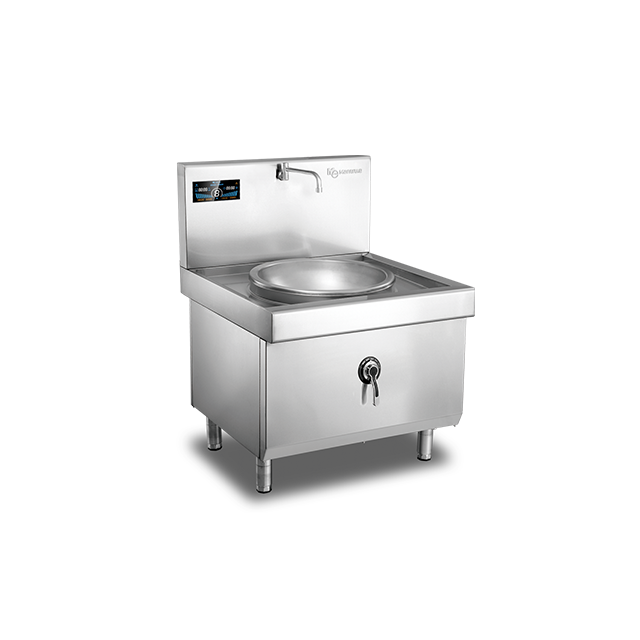
The 800 mm induction wok steps up to 20 kW at 380V and an equipment size of 1100 × 1100 × (810 + 440) mm. The additional wok size and power make this class worth considering when a restaurant regularly prepares larger batches, while still requiring a single dedicated wok station rather than a very large production vessel.
The D1000 induction wok cooker is configured at 25 kW and 380V with a 1300 × 1300 × (810 + 440) mm footprint. Its specified stir-frying capacity is 60 L, with a meal-volume reference of 200 people. That makes it a different production category from simply choosing a slightly wider restaurant wok.
The 200-person reference should not be treated as a universal restaurant throughput figure. Portion weight, recipe, batch loading, pre-preparation, cooking time, holding method, and the number of dishes being produced all affect actual service capacity.
One of the most common sizing mistakes is choosing a commercial induction wok from total daily customer count. Daily covers do not show how hard the wok station works during its busiest 30 or 60 minutes. A restaurant serving 300 customers evenly across a long service can require less wok capacity than a smaller restaurant receiving 80 stir-fry orders within one concentrated rush.
A better process starts with the peak production window. Identify how much wok-cooked food must leave the station during that period. Then identify the normal batch size that preserves the required cooking result. Finally, calculate how many batches each station must complete.
A simple planning relationship is:
Required batches per peak hour = peak-hour wok food demand ÷ practical batch load
Next, compare that number with the realistic cooking cycle for the actual menu. Use kitchen trials or established recipe timings wherever possible. Do not assume that doubling wok volume automatically doubles hourly output, because preparation, seasoning, loading, stirring, plating, and cleaning time can become the limiting steps.
For à la carte restaurants, several smaller batches may preserve speed and dish separation better than one very large batch. Conversely, a canteen preparing the same dish for many diners may benefit more from a larger commercial induction wok because production is naturally organized into bulk batches.
Menu mix is therefore as important as customer count. A kitchen producing ten different stir-fries simultaneously has a different requirement from one producing a single vegetable, rice, meat, or sauce preparation in repeated bulk cycles.
Oversizing can increase equipment footprint and electrical demand while making smaller batches less convenient. If future capacity is uncertain, evaluate whether adding another wok station later would provide greater flexibility than buying one oversized commercial induction wok now.
Rim diameter alone cannot tell you the practical batch volume. Ask for the complete wok dimensions, usable capacity where available, bowl profile, and matched cookware specification.
The fact that food physically fits inside a wok does not mean that load is appropriate for rapid frying. Working batch capacity should be based on the required cooking result rather than maximum vessel volume.
Menu diversity often favors parallel cooking. If several unrelated dishes must leave the kitchen simultaneously, two appropriately sized wok positions may create a better workflow than one very large wok that can process only one batch at a time.
High-power commercial induction equipment should be coordinated with the project's electrical design before purchase. Verify voltage, phase, available load, protection requirements, connection method, and applicable local standards with qualified project personnel.
Before requesting a final commercial induction wok configuration, prepare the operational information that actually changes equipment sizing:
Peak-hour number of wok dishes or required food output
Normal batch weight or volume for the main recipes
Typical cooking time per batch
Percentage of à la carte versus bulk cooking
Main cooking methods used at the wok station
Number of chefs and simultaneous wok positions required
Available width, depth, aisle space, and installation height
Available voltage, phase, and electrical capacity
Required wok bowl dimensions, curvature, and replacement cookware specification
Destination country and project-specific installation or certification requirements
This information is more useful than simply stating that the restaurant serves a certain number of customers per day. It connects equipment size directly to the production bottleneck the kitchen must solve.
The right commercial induction wok diameter should be driven by peak batch demand rather than the assumption that larger equipment is always more productive. A 600 mm class can suit flexible restaurant cooking, an 800 mm class provides more batch capability, and a D1000 configuration moves toward high-volume production. Final selection should still account for menu style, practical batch load, cooking cycles, station count, electrical supply, and available floor space. Shenzhen Mantru.E Commercial Equipment Manufacturing Co., Ltd., an all-electric commercial kitchen equipment manufacturer, offers these different size classes for projects with different production requirements.
There is no universal diameter for every restaurant. A 600 mm size is a practical starting point for moderate restaurant batches, while 800 mm can suit greater batch demand. Larger D1000-class equipment is more relevant when bulk production is a major requirement. Peak service volume, menu, station count, and practical batch size should determine the final choice.
No. A larger wok gives more potential working volume, but throughput also depends on heating power, batch loading, temperature recovery, cooking time, preparation, and chef workflow. An oversized batch can reduce the quality or speed advantage expected from a larger vessel.
Seat count is only an indirect indicator. The more useful measurement is how many wok dishes must be produced during the busiest service period. Two restaurants with the same seating capacity can need very different wok equipment if one has a wok-heavy menu and the other does not.
Diameter alone cannot be used to calculate practical capacity that way. Bowl depth, curvature and usable fill level also affect volume, while the acceptable batch load depends on the cooking method. Request complete bowl dimensions or stated capacity when capacity is a critical procurement requirement.
Not necessarily. A single large wok can be effective for repetitive bulk production, while two stations allow different dishes to cook simultaneously. Restaurants with varied à la carte menus should compare parallel cooking requirements before concentrating capacity in one oversized station.
Confirm power, voltage, phase, overall dimensions, bowl profile, cookware compatibility, control method, station layout, working height, cleaning and service access, electrical connection requirements, and the installation or certification requirements applicable to the destination market.


