


Views: 0 Author: Site Editor Publish Time: 2026-09-15 Origin: Site


A commercial kitchen does not need a certain number of induction zones simply because it has a certain number of seats. The better question is how many pans, pots, or woks must receive heat at the same time during the busiest service period. A commercial induction range with too few zones creates waiting and pan movement; one with too many can consume valuable line space and require electrical capacity that the kitchen never uses. For most buyers, the right choice becomes clearer after separating active cooking, long-hold cooking, specialty tasks, cookware size, and reserve capacity.
A useful starting point is to count every vessel that must be heated simultaneously at peak service, then include zones occupied by long-running sauces, soups, stocks, or other holding tasks. Finally, allow practical spare capacity for order surges or temporary overlap. The result is a better commercial induction range target than using restaurant seating alone.
Typical Zone Count | Where It Can Fit | Main Limitation to Check |
|---|---|---|
2 zones | Compact stations, specialized wok work, supplementary cooking, limited menus | Little capacity for overlapping pan-based orders |
4 zones | Compact restaurant lines, mixed menus, moderate simultaneous cooking | Long-hold pots can quickly reduce free capacity |
6 zones | Broader menus, busier pan stations, multiple simultaneous cooking tasks | Requires more space, connected power, cookware clearance, and staff utilization |
Multiple stations | High-volume kitchens or operations with separate cooking workflows | Layout and utility distribution become as important as total zone count |
The first step is to stop counting menu items and start counting simultaneous heated vessels. A menu may contain 40 dishes while only four pans normally require the range at once. Another operation may offer 15 dishes but need six pans, two sauce pots, and a stock pot running together during the same rush.
Create a simple peak-service map. Look at the busiest part of lunch or dinner and separate range demand into three groups: continuous zones, active-order zones, and temporary reserve zones. Continuous zones are occupied for extended periods by sauces, soup, stock, reductions, or other preparations. Active-order zones turn over as individual dishes are cooked. Reserve capacity absorbs short periods when orders overlap more heavily.
A practical planning formula is:
Peak active pans + long-occupancy vessels + reasonable reserve capacity = target heating positions.
Suppose two pans are usually sautéing entrées, one saucepan is finishing sides, and one pot remains occupied by sauce. That is already four simultaneous positions. A four-zone commercial induction range may technically handle the workload, but it has no spare position when another order arrives before one of those pans leaves the surface. In that situation, either additional zone capacity or a change in production method can reduce congestion.
The calculation should also distinguish between average and peak demand. Buying equipment for average use can leave the line undersized precisely when speed matters most. At the same time, sizing every station for an extremely rare event may create unnecessary capital, space, and utility requirements. The goal is repeatable peak-service capacity with a manageable margin, not the highest possible zone count.
Two restaurants serving the same number of customers can require very different commercial induction range configurations because the menu determines how long each heating position remains occupied.
Sauté, seafood, pasta finishing, sauces, vegetables, curries, and other pan-based dishes create frequent overlapping demand. These kitchens benefit from more independent heating positions because one pan cannot simply wait while another finishes without affecting production flow. Zone turnover may be fast, but simultaneous demand can rise sharply during a ticket surge.
A sauce that occupies one zone for most of service should not be treated like a pan that cooks for a few minutes and leaves. Long-hold tasks reduce effective capacity. If two of four positions are continuously occupied, the kitchen effectively has only two flexible zones for new orders.
This is where dedicated equipment can sometimes be more useful than simply adding more identical zones. Soup, pasta, frying, steaming, or large-batch production may be better separated from the main pan station when those tasks repeatedly block general-purpose cooking positions.
Wok operations should be evaluated by the number of woks that must work simultaneously rather than by flat-zone count alone. A dedicated Two-Wok Induction Station provides two specialized wok positions together with an integrated basin, giving wok production a different workflow from a flat multi-zone range.
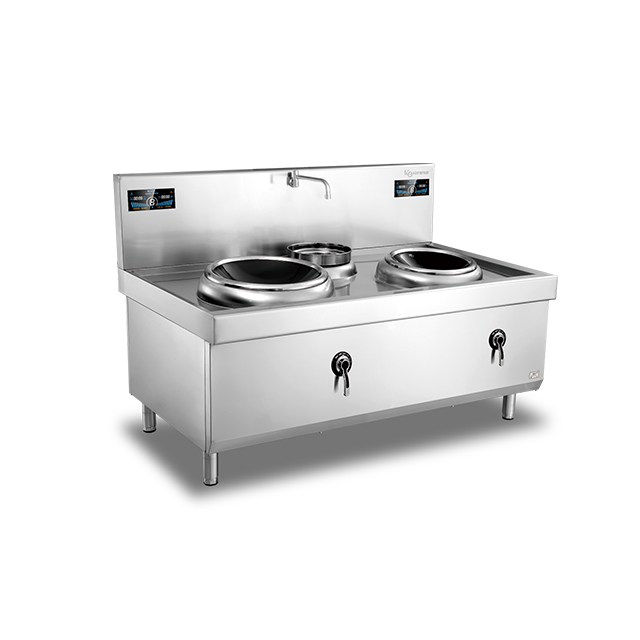
A wok-heavy kitchen may therefore need dedicated wok stations plus fewer flat zones for sauces, soups, preparation, or other pan cooking. Counting every cooking position as interchangeable can produce the wrong layout.
A kitchen where much of the production happens on a griddle, fryer, steamer, oven, rice cooker, or noodle cooker may require fewer general-purpose induction zones. Adding six zones does little if the menu only creates two or three simultaneous pan tasks. Equipment should divide the workload rather than duplicate unused capacity.
The difference between a small and large commercial induction range is not simply “more output.” Extra zones change line width, connected load, pan spacing, staff movement, and the number of tasks that can operate independently.
Configuration | Practical Role | Advantages | Watch For |
|---|---|---|---|
2 heating positions | Supplementary or specialized station | Compact footprint and focused workflow | Limited reserve capacity during simultaneous orders |
4 flat zones | Moderate multi-pan cooking | Balances capacity and line footprint | Can become constrained if several pots remain on the range |
6 flat zones | Broader, higher-concurrency pan production | More simultaneous cooking positions | Higher connected load and greater floor-space requirement |
Multiple separate ranges | Divided stations or very busy production | Can separate workflows and reduce cross-traffic | Additional installation points and layout complexity |
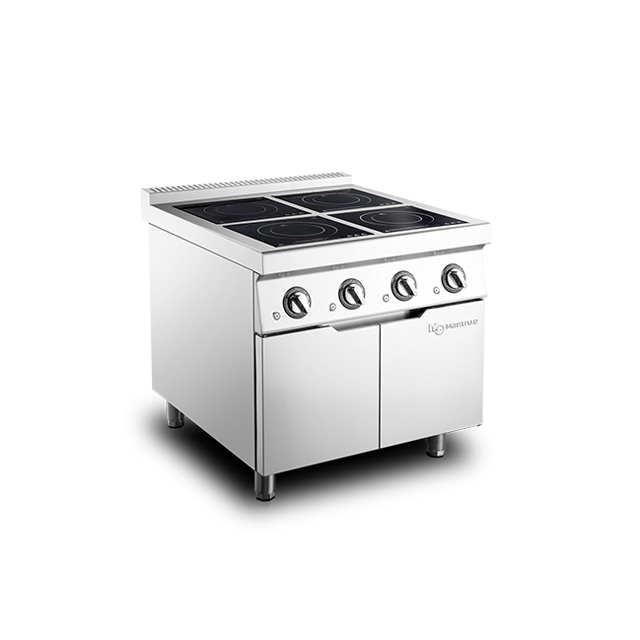
For a four-position layout, Mantru.E's Four-Zone Induction Range uses four heating positions and is designed for commercial cooking environments where multiple cookware pieces need independent heat control. This type of configuration can provide a practical balance between cooking capacity and installation space for many medium-demand applications.
Where six independent flat positions are justified, the Six-Zone Induction Range provides additional cooking positions for kitchens with higher simultaneous demand. However, larger configurations should always be evaluated together with available installation space, cookware requirements, workflow design, and electrical planning.
Before specifying two, four, six, or more heating positions, evaluate the actual production pattern instead of selecting equipment only by restaurant size.
Map the peak service period. Identify the busiest realistic period and list every pot, pan, or wok that may require heat simultaneously.
Separate long-hold and fast-turn tasks. A sauce pot occupying one position for hours affects capacity differently from a pan used for short cooking cycles.
Identify specialty cooking requirements. Decide whether wok cooking, frying, steaming, noodle production, or bulk preparation should use dedicated equipment.
Add practical reserve capacity. Avoid designing a station that reaches full occupancy during every normal rush period.
Check cookware dimensions. Confirm that intended pans fit the zone layout without blocking neighboring positions.
Evaluate staff workflow. Match the number of zones with the number of operators and their movement patterns.
Verify utilities before ordering. Confirm electrical requirements and installation conditions for the selected equipment.
Consider future menu changes. Allow enough flexibility for realistic production growth without selecting unnecessary capacity.
The key is to avoid treating additional zones as simple spare capacity. Every extra position affects equipment size, power requirements, workspace, cleaning area, and investment. A commercial induction range should remove real production bottlenecks while maintaining an efficient kitchen layout.
The right number of induction zones is determined by peak simultaneous cooking demand, not simply by restaurant size or customer capacity. Start by identifying active pans, long-occupancy pots, specialty cooking requirements, cookware dimensions, and staff workflow. A four-zone commercial induction range may provide a practical balance for many mixed-menu kitchens, while six zones can be more suitable when several pan-based tasks regularly overlap. Wok-focused operations may require dedicated wok equipment combined with flat induction positions. Shenzhen Mantru.E Commercial Equipment Manufacturing Co., Ltd. provides commercial electric cooking equipment including induction flat ranges and wok solutions that can be evaluated according to different kitchen production requirements.
There is no universal zone number that fits every kitchen. The correct configuration depends on how many cookware pieces need heat simultaneously during peak service, how many zones are occupied by long-running preparations, the menu structure, available space, and electrical capacity. Smaller operations may work efficiently with fewer zones, while high-demand cooking lines may require additional positions.
A four-zone induction range can be suitable when peak production requires only several simultaneous cooking positions and other equipment handles tasks such as frying, baking, steaming, or bulk preparation. If all four zones are regularly occupied during normal service, the kitchen may need additional capacity or a different workflow design.
A six-zone configuration becomes more practical when multiple pans, pots, or cooking tasks frequently operate at the same time. It can support higher cooking concurrency, but buyers should also consider installation space, connected electrical demand, cookware clearance, and whether staff can effectively use the additional positions.
No. Restaurant size alone does not determine heating requirements. A large operation using ovens, fryers, steamers, or batch cooking equipment may need fewer induction positions, while a smaller restaurant with a cook-to-order menu may require more simultaneous cooking capacity.
Yes, but wok stations should be evaluated separately from flat induction zones because they support different cooking methods and cookware. A wok-focused kitchen may benefit from dedicated wok positions combined with fewer flat zones for sauces, side dishes, and general pan cooking.
In some layouts, separate units can improve workflow by dividing cooking tasks, reducing congestion, and placing equipment closer to different production areas. A single larger range may provide a more centralized station. The better choice depends on menu requirements, kitchen layout, staffing, and utility planning.


