


Views: 0 Author: Site Editor Publish Time: 2026-08-31 Origin: Site


Induction hobs are a relatively new addition to commercial kitchens, but they are quickly becoming the go-to choice for many chefs and restaurant owners. Induction hobs offer a number of advantages over traditional gas and electric hobs, including increased energy efficiency, faster cooking times, and more precise temperature control. In this article, we will compare the energy efficiency of commercial induction hobs to gas and electric hobs and explore the benefits of using induction hobs in a commercial kitchen.
Induction hobs are a type of cooktop that uses electromagnetic energy to heat pots and pans directly. Unlike gas and electric hobs, which heat the cooktop surface and then transfer that heat to the pot or pan, induction hobs create a magnetic field that induces an electric current in the pot or pan, generating heat directly.
This process is incredibly efficient, with studies showing that induction hobs convert up to 90% of the energy they consume into usable heat. In comparison, gas hobs typically convert only 40-50% of their energy into heat, while electric hobs convert around 70-80% of their energy.
In addition to their energy efficiency, induction hobs offer a number of other benefits for commercial kitchens. They are incredibly fast, with some models able to bring water to a boil in less than half the time of a gas or electric hob. This can save valuable time in a busy kitchen and allow chefs to prepare food more quickly.
Induction hobs also offer precise temperature control, with many models featuring digital displays and programmable settings. This allows chefs to cook food to the exact temperature they desire, ensuring consistent results every time.
Another advantage of induction hobs is their safety. Because the cooktop surface does not heat up, there is less risk of burns or fires, making them a safer option for busy kitchens. Additionally, many induction hobs feature automatic shut-off functions that turn the hob off when a pot or pan is removed, further reducing the risk of accidents.
Overall, induction hobs are an incredibly efficient and versatile option for commercial kitchens. Their energy efficiency, speed, precision, and safety make them an increasingly popular choice for chefs and restaurant owners around the world.
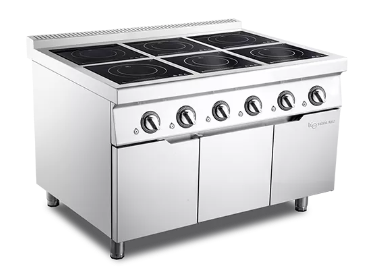
Gas hobs have long been the standard in commercial kitchens, and for good reason. They are incredibly durable and can withstand the heavy use of a busy kitchen. Additionally, gas hobs offer a high level of temperature control, allowing chefs to quickly adjust the heat as needed.
However, gas hobs are not without their drawbacks. One of the biggest issues with gas hobs is their energy efficiency. According to the US Department of Energy, gas hobs convert only 40-50% of the energy they consume into usable heat. This means that a significant amount of energy is wasted, resulting in higher energy bills and a larger carbon footprint.
In addition to their energy inefficiency, gas hobs can also be a safety hazard. The open flame used to heat the cooktop surface can easily cause burns or fires, and gas leaks are always a concern. While most modern gas hobs come equipped with safety features such as flame failure devices and automatic shut-off valves, these features can sometimes fail or be bypassed, putting kitchen staff at risk.
Despite these drawbacks, gas hobs remain a popular choice for commercial kitchens. Their durability and temperature control make them a reliable option, and many chefs simply prefer the feel of cooking with gas. However, as energy efficiency becomes a larger concern for both environmental and economic reasons, more and more commercial kitchens are beginning to look at alternative cooking methods, such as induction hobs.
Electric hobs are another popular option for commercial kitchens, and they offer a number of advantages over gas hobs. One of the biggest advantages of electric hobs is their energy efficiency. According to the US Department of Energy, electric hobs convert around 70-80% of the energy they consume into usable heat. This means that they are more efficient than gas hobs, resulting in lower energy bills and a smaller carbon footprint.
Electric hobs also offer precise temperature control, allowing chefs to quickly adjust the heat as needed. Additionally, electric hobs are generally easier to clean than gas hobs, as there are no grates or burners to remove and clean.
However, electric hobs are not without their drawbacks. One of the biggest issues with electric hobs is their speed. Electric hobs can take longer to heat up and cool down than gas hobs, resulting in longer cooking times. This can be a significant drawback in a busy kitchen where every second counts.
Another issue with electric hobs is their compatibility with pots and pans. Unlike induction hobs, which require specific types of cookware, electric hobs can be used with any type of pot or pan. However, some types of cookware, such as cast iron and copper, can take longer to heat up on an electric hob, resulting in longer cooking times.
Overall, electric hobs are a good option for commercial kitchens, but they may not be the best choice for every situation. Their energy efficiency and precise temperature control make them a popular choice, but their slower cooking times and compatibility issues can be a drawback in a busy kitchen.
In conclusion, commercial kitchens have a number of different cooking options to choose from, each with their own advantages and disadvantages. Gas hobs are a durable and reliable option, but they are not very energy efficient and can be a safety hazard. Electric hobs are a more energy efficient option, but they can take longer to heat up and cool down. Induction hobs are the most energy efficient option, but they require specific types of cookware and can be more expensive upfront.
When choosing a cooking option for a commercial kitchen, it is important to consider a number of factors, including energy efficiency, cooking times, compatibility with cookware, and cost. By carefully weighing these factors, kitchen managers and chefs can choose the option that is best suited to their needs and the needs of their kitchen.


